

Is The NIL Era Killing UGA Football Recruiting?


For most of the last decade, the formula for elite college football seemed relatively straightforward: recruit the best high school players, develop them, stack depth, and let coaching separate contenders from pretenders. Under Kirby Smart, Georgia mastered that formula as well as anyone in the country. But college football is no longer operating under the old system.
The question now facing Georgia fans isn’t whether Smart can still coach—few would debate that—but whether Georgia’s current approach to roster building can survive in a rapidly changing marketplace. The rise of NIL, unrestricted player movement through the transfer portal, and the increasing professionalization of recruiting have fundamentally and PERMANENTLY altered the sport.
That concern is beginning to show up in recruiting conversations.
Georgia enters the summer ranked outside the top-10 in recruiting rankings for the first time in the Kirby Smart era. Reputable sites like ESPN, On3, and 247 differ on the level of concern (or panic) Dawgs fans should feel over the 2027 class, but UGA ranks as low as 24th in some of the composite recruiting rankings – a fall of biblical proportions from the string of top-five classes Smart has replicated for the last decade. While recruiting rankings in June are notoriously incomplete, the anxiety isn’t necessarily about the number beside Georgia’s name; it’s about why things feel different.

In the modern recruiting environment, strong commitments happen increasingly earlier with NIL agreements, financial guarantees, and agent involvement making it increasingly difficult to “flip” top recruits. Many schools even incentivize top prospects to completely close their recruiting, leading to cream-of-the crop players making decisions in June rather than December (or February) in hopes of locking in financial packages long before signing day.
That seismic shift hurt programs like Georgia that historically thrived by closing late and winning through relationships, the promise of development, and on-campus momentum.
Critics of Georgia’s current strategy worry the Bulldogs are trying to play yesterday’s game. If top-tier programs such as Texas, Texas Tech, Miami, Oregon, or Texas A&M are aggressively (perhaps irresponsibly) spending to secure elite talent, can Georgia continue competing near the top of the sport while taking a more measured approach?
Is it even the right approach?
Over the last few recruiting cycles UGA has been repeatedly and publicly outbid for elite talents like OL Jackson Cantwell, LB Tyler Atkinson, DL Justus Terry, and QBs Jared Curtis and Arch Manning among others. It’s rare that losing any singular non-QB prospect derails the trajectory of an entire program, but multiple cycles losing three or four potentially elite starters is a rapid detour down the path to mediocrity.
Smart has been clear that unproven high school players will not receive top-tier pay over proven and vested veteran players. Georgia believes in scaling their high school NIL deals relative to where a player projects on their depth chart to avoid a distorted locker room hierarchy where backups and scout team players make more than starters.
That makes sense.
The issue in a building FULL of blue chip prospects is that an incoming five-star that might start day one at other Power 4 schools may be third on the UGA depth chart – especially at loaded positions like running back, tight end, or linebacker. Between the narrower path to playing time and the measured approach to freshman NIL deals, it makes sense why Georgia is no longer the top choice for a lot of blue-chip prospects.
From a macro level, the concern isn’t simply losing one recruiting class—it’s whether Georgia’s long-term championship ceiling drops if elite talent acquisition slips from “best in the country” to merely “very good.” That’s the $48 million question.

The counterargument is that there still isn’t definitive proof that spending the most money guarantees championships. Recruiting rankings matter, but coaching, development, culture, and retention still matter too…at least, we think. Georgia has won consecutive SEC championships despite falling behind Texas A&M, LSU, Texas, Tennessee, Alabama, and Ole Miss in team NIL valuations. And while Indiana just shattered college football’s hierarchy
with a championship team built on underrecruited fourth and fifth-year transfers who executed at an elite level, even the most optimistic fans would acknowledge that championship path as a complete aberration. The fact remains that seven of the top-10 spenders in college football made the College Football Playoff last year with one of the biggest spenders (Miami) coming within minutes of a national championship. Spending doesn’t guarantee that you will be good, but it’s impossible to argue it doesn’t help.

But there are warning signs for the “highest bidder” approach as well. Paying premium prices for players doesn’t eliminate risk precisely BECAUSE player development and coaching still matter. Texas QB Arch Manning is the poster child for what happens when a centerpiece prospect underperforms. Texas regressed to 9-3 in 2025 after making the CFP semifinals the previous two years, despite lauding Manning as a massive upgrade at the most important position on the field. While there is still plenty of runway for Manning to right the ship and lead a loaded Longhorns roster to the promised land, there has to be some pause about a $6.8 million quarterback with a proven offensive coach ranking just sixth in the conference in passing yards and seventh in passer rating at just a 61% completion rate. It's evidence that even the wealthiest programs may struggle to overcome misses at the most impactful positions on the field.
Perhaps the truth lies somewhere in the middle.
Georgia may not need to become college football’s biggest spender, but the Dawgs likely cannot ignore the new financial market either. While Georgia’s current roster boasts one of the highest blue-chip ratios in program history, the downward trend in recruiting is both undeniable and alarming. Instead of having superior talent to 90% of the programs in college football and working to outscheme, outcoach, and outdevelop a handful of elite
programs with comparable talent, Georgia now faces the very really possibility of having to outscheme, outcoach, and outdevelop teams with SUPERIOR blue chip talent.
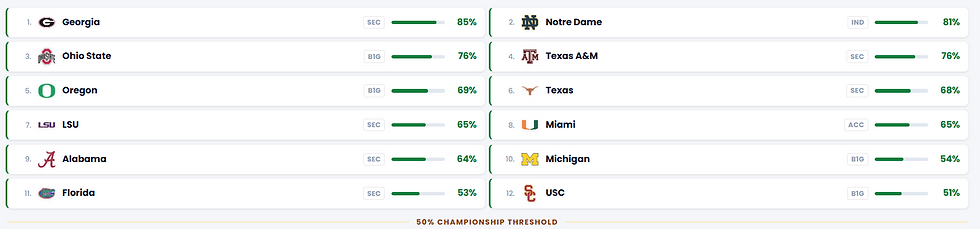
That’s not an impossible task, but it shrinks the margin for error to an uncomfortably small range. Injuries become even more catastrophic. Play calling MUST be elite. Player retention – both to the portal and the draft – is non-negotiable. That’s a difficult needle to thread each and every year in perpetuity…or until the government steps in with rigorous financial oversight.
The old advantages—facilities, recruiting budgets, relationships, and brand prestige—matter much less than they once did. Today, roster construction increasingly resembles professional sports: part recruiting, part salary management, and part player retention. But all that without the protection of collectively bargained parameters and the additional challenge of an entire roster that can enter free agency every January.
Kirby Smart has already proven he can build a championship machine. His mentor, Nick Saban, owed a lot of his success to his uncanny ability to see, predict, and rapidly adapt his Alabama machine to changes in college football both on the field and off. Proliferation of the spread offense? Bring in Lane Kiffin to modernize the scheme. Unrestricted player movement? Proactively target the best players from other programs. Every time the questions changed, Saban seemed able to find answers faster than anyone else. This is the challenge for Kirby Smart.
Can he and will he adapt his machine to a sport evolving in real time around him? If not, is the current crop of blue chip talent a sunset on the elite years of one of college football's best programs?
If you enjoyed this article, please like and share and make sure to check out more of our content on Facebook! You can also follow Title Run Sports on Twitter.
Also make sure to listen and subscribe to our podcast on Apple Podcasts, Spotify, and all major podcasting platforms.

Comments